Eternal glory awaits those who …

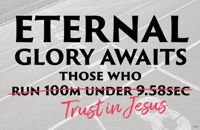
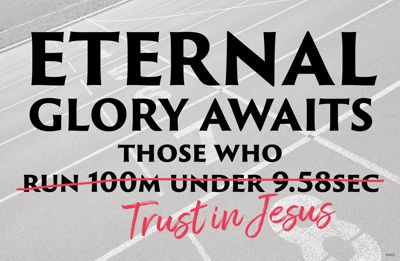
Eternal glory awaits those who trust in JesusHave you ever dreamed of excelling at something? Being the world’s best? Having crowds cheer for you? To have people say your name with awe and speak well of you. Respect. Kudos. Glory. Fame.

A few, like Usain Bolt and Cathy Freeman, attain glory through their outstanding speed at running. For most of us such worldwide renown is never going to happen. Yet there is something in us that still wants glory of one kind or another. If it’s not standing on the winners podium at the Olympics perhaps we hope to excel and be recognised in our profession; to score the winning goal, try or run in our local sport team; to receive academic awards and scholarships; get 10,000+ followers online; be the funniest person in the room; be the most attractive person in the room … Our desire for praise and honour often drives us in various areas of our lives.

Did you know the Bible says we are actually designed for glory? These worldly hopes and dreams are a shadowy glimpse of the eternal glory we deeply desire and were created to enjoy. The apostle Paul experienced quite the opposite to accolades and glory in his time. He was beaten and imprisoned for following Christ. His teaching was challenged and criticised by other so-called Christians. He was mocked by many as being weak, stupid and insane. Yet he writes to the church,

“our light and momentary troubles are achieving for us an eternal glory that far outweighs them all” 2 Corinthians 4:17.

Paul isn’t saying that suffering in this life earns glory in heaven. Paul is saying that trusting Jesus, despite whatever suffering it may result in, is nothing compared to the resplendent everlasting glory we will enjoy with Jesus in the next life.

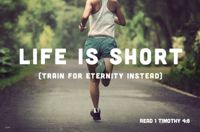
We could make the comparison to the things an athlete must endure when training. All the physical effort and pain and sacrifices pale into insignificance when they are standing on the winners podium before the world’s applause. And so whatever we must suffer in this life, as real and hard as it is, will be worth it if we trust Jesus. Even more so, the kind of momentary glory of an Olympic win is nothing compared to what those who trust Jesus are promised for all eternity.

Do you want glory? Do you want deep, true and lasting glory? Don’t settle for the shadowy, fleeting glory of this world, seek Christ, trust in His deep love and forgiveness, and you will share in His eternal glory that outweighs all else.

Read 2 Corinthians 4 and 1 Peter 5 for more about sharing in God’s glory.

Prayer: Dear Jesus, show me your glory, your love and your forgiveness. I want to trust in you whatever hardship that may bring. Help me not to seek or settle for the fleeting glory of this world. Lead me in this life to glorify you and share your glory for eternity. Amen.

Acknowledgement: This article was sourced from Outreach Media, Sydney, Australia.
Images and text © Outreach Media 2024
Posted in Blog | Leave a comment

Prophecies about Jesus: He would be betrayed

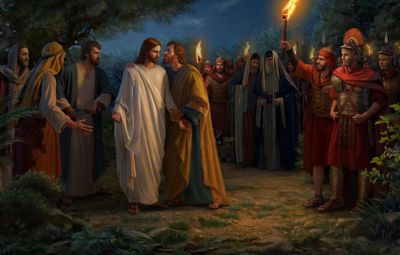
Judas Iscariot betrays Jesus ChristDid you know that the betrayal of Jesus by Judas Iscariot was not an accident, as it was predicted in Old Testament times?

After David had reigned for about 30 years, his son Absalom conspired to become king. So David and his men left Jerusalem for the Jordan valley. David’s counsellor Ahithophel betrayed him by joining the conspiracy (2 Sam. 15:12, 31; 16:15). Ahithophel’s advice was considered to come from God (2 Sam. 16:23). He advised Absalom to attack David “tonight” while he is resting (2 Sam. 17:1-4). But when Absalom also consulted Hushai he was advised to gather warriors from all the tribes of Israel before attacking David and his men (2 Sam. 17:5-13).

Then the Bible says, “When Ahithophel saw that his advice had not been followed, he saddled his donkey and set out for his house in his hometown. He put his house in order and then hanged himself. So he died and was buried in his father’s tomb” (2 Sam. 17:23NIV). He was convinced that the rebellion would fail and that he would be found guilty of treason.

David may have been thinking of this betrayal when he said, “Even my close friend, someone I trusted, one who shared my bread, has turned against me” (Ps. 41:9). Jesus applied the second part of this verse to Judas Iscariot when He predicted the betrayal by Judas before it happened and said that when it occurred it would convince His disciples that He was the Messiah (Jn. 13:18-27).

So Ahithophel betrayed king David and then suicided, just like Judas Iscariot betrayed Jesus and then suicided. It was a pattern prophecy (topology) given 1,000 years beforehand that was only evident in hindsight. They didn’t know that the pattern would be repeated in the betrayal of Christ.

What else does the Old Testament say about the betrayal?

When Zechariah’s leadership of Judah was rejected, he asked for wages and was paid 30 pieces of silver (Zech. 11:2-13). Then he threw the money away to the potter at the temple. This was the redemption price of a slave who had been gored to death by an ox (Ex. 21:32). That’s what Judas accepted to betray Jesus – the wages for 120 days (4 months) work (Mt. 26:14-16). He valued Jesus as much as a slave! When Judas realised his mistake, he threw the money to the priests in the temple like Zechariah did 500 years beforehand (Mt. 27:5).

When enemies tried to remove king David, he prayed that God would remove them (Ps. 69:25). After the ascension of Christ, Peter applied this verse to Judas – God had removed him when he suicided (Acts 1:20).

In another prayer against his enemies David, prayed “may his days be few; may another take his place of leadership” (Ps. 109:8). Peter applied this when he said they must choose another apostle and Matthais replaced Judas Iscariot (Acts 1:20).

Judas didn’t know it, but his betrayal fulfilled these four pattern prophecies given by the Holy Spirit hundreds of years before he was born. This shows that nothing happens by accident. Everything fits into God’s plan. Everything was planned by God down to the tiniest detail.

Judas is an example of how God can use evil for His own good purposes. God allowed Judas to betray Jesus so that Jesus could become the Saviour of the world.

Prayer

Father God, we thank you that in all things you work for the good of those who love you. You used the sin of Judas Iscariot to bring salvation to humanity. The betrayal lead to the arrest, which lead to the trial, which lead to the conviction, which lead to the penalty, which was Christ’s death on the cross. This lead to the grave. But we rejoice that this wasn’t the end. On the third day, this lead to the resurrection, and this lead to the ascension to heaven 40 days later.

The details of the betrayal show us that everything fits into your plan. You control both the means and the ends. Every event in the universe comes under your sovereignty. In Christ’s name, Amen.

G Hawke

Posted in Blog | Leave a comment

When “blood” means “death”

In the Bible, the word “blood” is often associated with violent deathWhen we sing songs like “Nothing but the blood of Jesus” and “Forgiveness is bought with the precious blood of Jesus Christ”, do we understand what the words mean? Or when we hear that our sins can be washed away by the blood of Jesus, what does that mean?
In the first Lord’s Supper, Jesus said that His blood “is poured out as a sacrifice to forgive the sins of many” (Mt. 26:27NLT). And at the crucifixion of Jesus Christ Pilate told the crowd, “I am innocent of this man’s blood. The responsibility is yours!”. And the people replied, “We will take responsibility for His death” (Mt. 27:24-25; Acts 5:28; 20:28). So in the Bible the word “blood” is often associated with violent death. This originated from the Old Testament where in their sacrifices “blood” stood for sacrificial “death”. Animals died on behalf of the people. This is a synecdoche, which is a figure of speech where the word “blood” stands for “bloodshed” or violent death. This figure of speech is also used in the New Testament. So blood as a symbol of death appears throughout the Bible.

The main benefit of the death of Christ is that Jesus as the sinless Son of God paid the penalty for our sins in His death for us on the cross. Our sins can be forgiven and we can be reconciled with God. For example, “For you know that God paid a ransom to save you from the empty life you inherited from your ancestors. And it was not paid with mere gold or silver, which lose their value. It was the precious blood of Christ, the sinless, spotless Lamb of God” (1 Pt. 1:18-19).

Not only does the blood [death] of Christ rescue His followers from the penalty of sin, but the passages that mention His “blood” say that they receive other benefits like:
– It rescues us out of a sinful way of life and saves us from God’s condemnation (Rom. 5:9).
– It purifies our consciences from sinful deeds (Heb. 9:14).
– It makes us holy (Heb. 13:12; 1 Jn. 1:7). We are sanctified (progressively cleansed from sin).
– It unites us with Christ and brings us near to God (Eph. 2:13). We can come close to God.
– It reconciles us with God; gives peace with God; and makes us holy and blameless before God (Col. 1:20-22).
– It makes us right [justified] in God’s sight (Rom. 3:25; 5:9).
– We are part of the new covenant (1 Cor. 11:25; Heb.13:20).
– It puts us in the church where there will be people from all nations (Acts 20:28; Rev. 5:9), and
– It enables us to enter heaven and be present with God (Heb. 10:19).

There was nothing in the physical appearance of Jesus that marked Him out as special. He wasn’t special in ways that count with us. Until Christ’s baptism, John the Baptist didn’t know that Jesus was the Messiah (Jn. 1:31). But John and Jesus were cousins and knew each other growing up. So Jesus would have had a blood type that was common to humanity. There was nothing special about the blood in His body.

The hematology of the fluid in His body was not important, it was the violent death and resurrection of the innocent, sinless Son of God that matters. “The blood of Christ” means the sacrificial death of Christ.

Prayer

Father God, we thank you that the death of Jesus Christ was a vicarious sacrifice – He was a substitute for us and we received the benefits. His death was effective because it was the death of a unique sinless person.

We thank you for the many benefits that we can receive through the death of Christ including being made right in God’s sight, forgiveness, reconciliation, being made holy and blameless, and having fellowship with yourself and with others in the church and entering heaven. In Christ’s name, Amen.

Posted in Blog | Leave a comment

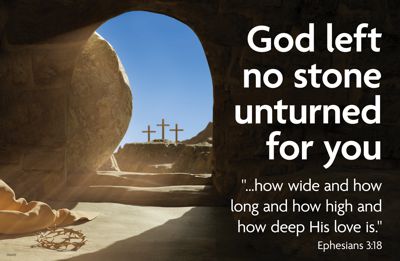
God has left no stone unturned for you

God has left no stone unturned for youWhat would you do to get back someone precious that you’d lost? What lengths would you go to to find your missing child, friend, spouse or parent? How far would you travel? How long would you look? What price would you pay?

The Bible says we have been lost to God – wayward, estranged, dead to Him in our apathy and rejection. Yet He wouldn’t let it be. He had to come find us. That is the story of Jesus – God come to earth to seek us, to be with us, and to ask us to follow Him. That is the story of the cross – God come to earth to suffer like us and for us and our waywardness. That is the story of the empty tomb – God triumphant over death and suffering and our estrangement from Him.

That is, as it says in the Bible in Ephesians 3:18, “how wide and long and high and deep the love of Christ is.”

God has left no stone unturned to be reunited with you.

What is your response to God’s deep and costly love for you? Isn’t this self-sacrificing, persistent, genuine love exactly what you need and want?

Why not open your heart to God’s wide, long, high and deep love for you in Christ right now?

Prayer: Dear God, I want your love and I receive your love. I trust that Jesus Christ has come and died and risen to life to reunite me to you. Please help me to live trusting in you and your love from now on. Amen.

Acknowledgement: This article was sourced from Outreach Media, Sydney, Australia.
Images and text © Outreach Media 2024.

Posted in Blog | Leave a comment

Don’t be afraid

God knows you so well, He can count the number of hairs on your headAustralians spend $1.6 billion a year on hair care. We want to remove hair from some places and grow it in others, colour and repair our hair, straighten and curl our hair, feed, wax, laser, nourish, and cut our hair.

Did you know Jesus talks about His followers’ hair? In speaking to His followers about their physical safety, financial security, and outward appearance (it seems people’s concerns haven’t changed much in over 2000 years), Jesus assures those who trust Him they are deeply known and cared for by Him and His heavenly Father.

Jesus said to them, “Are not five sparrows sold for two pennies? Yet not one of them is forgotten by God. Indeed, the very hairs of your head are all numbered. Don’t be afraid; you are worth more than many sparrows” (Luke 12:6-7).

Jesus isn’t promising Christians they will get everything they want as soon as they want it. Rather, He is calling us not to worry about the puny attempts of others to harm us or the transient glory of wealth and physical beauty. Why not worry? Because God has everything in hand. He knows the destiny of every sparrow and the details of every hair on your head. So come what may in this life, even dreaded baldness, those who publicly acknowledge Jesus as Saviour and Lord, Jesus says He will acknowledge “before the angels of God” (Luke 12:8). Those who seek God first rather than worldly securities and pleasures will, in eternity, if not before, be given all things (Matthew 6:33).

What does it mean to you that God knows you so intimately and cares for you so deeply? Have you made a commitment to entrust yourself to God’s care and seek Him above all else?

Prayer: Dear Heavenly Father, May I trust myself into your loving care. May I acknowledge Jesus as my Lord and Saviour whatever discomfort that may bring me. Please help me to seek you above all else. Amen.

Acknowledgement: This article was sourced from Outreach Media, Sydney, Australia.
Images and text © Outreach Media 2024

Posted in Blog | Leave a comment

Figures of speech in the Lord’s Supper

Figures of speech in the Lord’s SupperJesus used lots of metaphors like, “I am the bread of life” (Jn. 6:35); “I am the light of the world” (Jn. 8:12); “I am the good shepherd” (Jn. 10:11), and “I am the true vine” (Jn. 15:5). So it’s not surprising that there are figures of speech like this in the passages in the Bible about the Lord’s Supper (Mt. 26:26-29, Mk. 14:22-25, Lk. 22:19-20; 1 Cor. 11:23-26).

What are the main figures of speech in this passage?

The Lord Jesus, on the night He was betrayed, took bread, and when He had given thanks, He broke it and said, “This is my body, which is for you; do this in remembrance of me.” In the same way, after supper He took the cup, saying, “This cup is the new covenant in my blood; do this, whenever you drink it, in remembrance of me.” For whenever you eat this bread and drink this cup, you proclaim the Lord’s death until He comes. (1 Cor. 11:23-26)

The Lord’s Supper is a reminder of the death of Jesus just like the Passover celebration was a reminder of when God delivered the Israelites from slavery in Egypt. But it mentions, bread, my body, a cup, my blood, and the new covenant. There are at least three kinds of figures of speech here.

Metaphor

A metaphor implies a comparison between two things that have something in common but are in general different from each other (they are not related). It’s like saying, “You are my sunshine” or “It is raining cats and dogs” or “The Lord is my shepherd”.

The bread they were to eat was likened to Christ’s body. It represented His body. In the Passover it was unleavened bread (without yeast). As yeast is a symbol of sin in the Bible, the bread could remind us that Jesus never committed sin. Because His body was like the curtain in the temple that was torn in two (Lk. 23:45; Heb. 10:19, 29), the bread can remind us of the suffering He endured from the Jews and the Romans. And because bread was the staple food for physical life, it can remind us that faith in Jesus is necessary for spiritual life.

Metonymy

A metonymy (me-ton-y-my) is where something is described by something else that is associated with it (or related to it). Like, “can you give me a hand?” or “the team needs some new blood” or when “crown” means “king”.

Then they were told to drink from the cup. Paul calls it to “drink this cup” and he mentions someone who “drinks the cup of the Lord” (1 Cor. 11:26-27). But we drink the contents, not the cup. In this case, the container is substituted for the contents. The cup stands for its contents. Like “God so loved the world”, which means the people who inhabit the earth. So in this context, “cup” means “wine” (or grape juice).

Another metaphor

The cup they were to drink from was likened to “my blood of the (new) covenant … ” (Mt.26:28). So the wine was likened to blood, which is another metaphor.

Synecdoche

A synecdoche (sin-NECK-doc-key) is when a word for a part of something is substituted for the whole thing. Like: a room of happy faces (for people); give me a hand (for help), hungry mouths (for people) to feed; and look at my new set of wheels (for a car). Or using the term “Breaking of bread” to describe the Lord’s Supper (Acts 2:42; 20:7), which includes the “drinking of the cup” as well (1 Cor. 11:24-26).

In the Old Testament “blood” often stands for “bloodshed” or violent death or murder. Christ’s suffering included bleeding. In the New Testament, the word “blood” often means all aspects of the sacrificial death of Christ. So the wine represents blood, which represents the sacrificial death of Christ.

More metonymy

The word “blood” is associated with a covenant because in the Old Testament covenants were ratified by the blood of sacrificial animals. Jeremiah prophesied that God would make a New Covenant with His people (Jer. 31:31-34; 32:37-40). Jesus’ death for sin ratified the New Covenant.

The “blood” is also said to be “poured out for many for the forgiveness of sins” (Mt.26:28). The word “blood” is associated with the death of Christ (via “blood-shed”). And forgiveness was one of the benefits of Christ’s sacrificial death (Mt.26:28).

Prayer

Father God, we thank you that the bread and wine are visual reminders of Jesus’ sacrifice for our sins. The bread reminds us of His sinless life and His suffering for us, which was the source of our spiritual life.

And the cup of wine reminds us of blood, which reminds us of bloodshed, which reminds us of the horrible suffering that the Lord endured in His sacrificial death on the cross.

But what seemed like bad news was really good news because Jesus’ death for sin ratified the New Covenant and enabled many benefits like forgiveness of sin and eternal life with the Lord. In Christ’s name, Amen.

G Hawke

Posted in Blog | Leave a comment

Wyrrabalong National Park and Norah Head

Saturday 22 June 2024

Walk Lillipilli Loop, Red Gum Trail and along the coast near Norah Head Lighthouse. Coastal rainforest, coastal views and rock platform. Transport (mini bus) available from North Ryde (8.15am) and Hornsby (8.40am). Return by 6pm.

Leader : George Hawke 0422 659 589

Grade : Medium (9 km)

Sydney Christian Bushwalkers

Posted in Bush walk | Leave a comment

Zig Zag Railway Walk & Farmers Creek, Lithgow

Walk with Sydney Christian Bushwalkers on 20 April 2024


This slideshow requires JavaScript.

Sydney Christian Bushwalkers (opens in a new window)

Posted in Bush walk | Tagged , , | 1 Comment

God knows everything about you, and still loves you

God knows everything about you, and still loves youHow much of yourself do you feel you must filter when you’re with others? Of course, “others” isn’t a single category; there are many types of others in our lives, from our social media contacts to our closest friends or family members. Is there someone whom you feel you can truly be yourself with? Someone with whom you can express your vulnerable feelings, talk about your deepest struggles, and share your worst moments? We humans learn from a very early age that sharing our deepest parts, especially those we may not like, can be uncomfortable. That’s what happens when we see a toddler hide or cover their face when they know they’ve done the wrong thing. Experiencing rejection, condemnation, or exploitation after revealing our vulnerable parts is incredibly emotionally painful.

God knows everything about you. Everything – not only everything you’ve ever done but everything you’ve ever wanted to do, every thought, feeling, desire. As the ancient Israelite king David declared:

You have looked deep into my heart, Lord, and you know all about me… Nothing about me is hidden from you! (Psalm 139:1, 15)

Does that terrify you? Does it make you want to hide, defend yourself, or shake your fist in defiance and declare your autonomy?

But… God knows everything about you and still loves you.

“God demonstrates His own love for us in this: While we were still sinners, Christ died for us” Romans 5:8

There’s a kind of relational dichotomy here that we often find hard to grasp. Yes, God declares humans to be sinners. He doesn’t simply look away from our bad bits and mutter platitudes such as “It’s all good” or “I know you didn’t really mean it.” He sees it, He feels it, and He still loves us.

Have you experienced this level of intimate love? One in which you don’t have to hide anything; you can’t hide anything, and you are still loved and safe. Can you imagine this intimate relationship with God? Because Jesus’ death paid for your sin and because God already knows everything about you, you can express all your feelings, talk about your deepest struggles, and share your worst moments with God confident in His love for you.

Would you like this secure intimate relationship with the God of the universe? You can reach out to Him right now.

Prayer: Dear God, Can it be true that you really love me? I believe I am a sinner who has done wrong by you and others. Help me also believe I am deeply loved and forgiven because of Jesus’ death. Help me to share my whole self with you and enjoy intimacy with you. Amen.

Acknowledgement: This article was sourced from Outreach Media, Sydney, Australia.
Images and text © Outreach Media 2024

Posted in Blog | Leave a comment

The sharp end of Easter

The pointy end of Easter is that Jesus died for you, for me, for all of usIf I type “Easter” into my phone the emoji of a cute baby chick in an egg shell comes up. At the shops there are pictures of soft fluffy bunnies and mountains of sweet chocolate eggs. Easter ads show cherub-like laughing children running through green gardens, and generations of family members gathering happily around delicious feasts.

The sharp end of Easter looks very different to this. Jesus Christ nailed to a wooden cross is a horrific image. It’s understandable we’d rather put it out of our mind and think of bunny rabbits. But with the horror of Jesus’ crucifixion there is also something wonderful. Something worth celebrating all over the world year after year for thousands of years. Something worth closing the shops, taking time off work and spending time with loved ones feasting and rejoicing over.

The pointy end of Easter is that Jesus died for you, for me, for all of us. As it says in the Bible in the book of Romans

“God gave Jesus to die for our sins, and He raised Him to life, so that we would be made acceptable to God” Romans 4:25

Now here we have something else difficult to look at – we are sinners and as sinners we are not acceptable to God without forgiveness. It’s a hard truth, possibly the hardest truth to face. But if we are brave enough to reflect honestly on ourselves we know we have hurt others, we have hurt ourselves, we have rejected God – and that is what sin is.

So we come to the horrible-wonderful paradox of the sharp end of Easter – we are sinners but we are loved by God; in our sin we are unacceptable to God but in Jesus’ crucifixion we are made acceptable; Jesus was condemned, forsaken and crucified and Jesus was resurrected to eternal glory.

Are you willing to contemplate the horrible-wonderful sharp end of Easter this year?

Prayer: Dear God, Please open my eyes to the truth about Easter, the truth about my sin and the truth about Jesus’ death and resurrection. May I trust Jesus’ death to make me acceptable to you. Amen.

Acknowledgement: This article was sourced from Outreach Media, Sydney, Australia.
Images and text © Outreach Media 2024

Posted in Blog | Leave a comment